
• Sunrise At: 5:15 AM
  • Sunset At: 7:34 PM

Today's Prayer Times

9th Ramadan, 1447 - - Sydney, Australia

  • Fajr 5:16 AM Iqamah:
  • Sunrise 6:43 AM Iqamah:
  • Zuhr 1:08 PM Iqamah:
  • Sunset 7:33 PM Iqamah:
  • Magrib 7:53 PM Iqamah:
  • Jumah Zuhr time Iqamah: 12:00 PM

Welcome To Muhammadi Welfare Association

Community Center for all

Learn More

MUHAMMADI WELFARE ASSOCIATION INC was founded in 1989 by a group of professionals and university students in Australia. It is an independent initiative whose long term aspirations centre on the preparation for the blessed return of the Saviour, Imam Al-Mahdi (atf).

The best of you in the sight of Allah (s.w.t.) is the most righteous of you.

Surah Al-Hujurat

(49:13)

Recent News & Updates

Comments Box SVG iconsUsed for the like, share, comment, and reaction icons
Assalam O Alaykum,

It is with deep sadness to inform you that Marhoom Turab Ali Jeddy S/o Late Marhoom Mahmood Ali Jeddy, who passed away in Chennai, India

Marhoom was cousion of brother Tanver Jeddy.

Please recite Surah Fateha and remember Marhoom in your duas and pray that Allah may grant him an exalted place in Jannah, and sabr-e-Jamel to the family members.

Thank you,

Muhammadi Welfare Association

Assalam O Alaykum,

It is with deep sadness to inform you that Marhoom Turab Ali Jeddy S/o Late Marhoom Mahmood Ali Jeddy, who passed away in Chennai, India

Marhoom was cousion of brother Tanver Jeddy.

Please recite Surah Fateha and remember Marhoom in your duas and pray that Allah may grant him an exalted place in Jannah, and sabr-e-Jamel to the family members.

Thank you,

Muhammadi Welfare Association
... See MoreSee Less

9 hours ago

... See MoreSee Less

21 hours ago
MWA Youth Presents

MWA Youth Presents ... See MoreSee Less

21 hours ago
*Summary of the Eighth Juz 8*
Audio link:  https://tinyurl.com/2b37s627

This Juz contains two sections:
1. The remaining part of Surah An’aam
2. The beginning of Surah A’raaf

First Part: Surah An’aam
This section covers the following key topics:
1. Comforting the Holy Prophet (PBUH)
• The disbelievers are stubborn and demand unnecessary miracles but still refuse to believe.
• Even if the dead were to speak or angels descended, they would not believe.
• The miracle of the Quran is sufficient for those willing to accept faith.
2. Four Foolish Acts of the Polytheists
1. They divided their crops and livestock between Allah and their partners, but only preserved the partners share, not Allah’s.
2. They killed their daughters out of fear of poverty and shame.
3. They divided their cattle and crops into three parts:
o Some were reserved for their religious leaders.
o Some were prohibited from being ridden.
o Some were slaughtered in the name of deities other than Allah.
4. They forbade their cattles offspring for women, except if it was stillborn, then both men and women could eat from it.
3. Two Great Bounties of Allah
1. Crops (agricultural produce)
2. Livestock (cattle and animals)
Allah has granted different levels of blessings to people as a test.
4. Ten Fundamental Commands (Verses 151-153)
1. Do not associate partners with Allah.
2. Be kind to your parents.
3. Do not kill your children.
4. Avoid all forms of sin, apparent or hidden.
5. Do not kill anyone unjustly.
6. Do not consume the wealth of orphans.
7. Be fair in weight and measure.
8. Speak justly at all times.
9. Fulfill your covenant with Allah.
10. Follow the straight path.
5. Additional Important Points
• Sins exist in both apparent and hidden forms. (Verse: 120)
• Faith = Life, Disbelief = Death. (Verse: 122)
• The path of Ahlul Bayt is the path of Allah. (Verse: 153)
• Those who divide into sects have no connection with the Holy Prophet (PBUH). (Verse: 159)

Second Part: Surah A’raaf
This section includes the following themes:
1. The Bounties of Allah
• The Holy Quran (as guidance for humanity)
• Mankinds authority on earth
• The creation of man and his superiority (as the angels were commanded to prostrate)
• The Scale of Deeds (Mizān), interpreted in some traditions as the Imams (AS)
2. The Story of Prophet Adam (AS) and Iblis
• Allah created Adam (AS) as His vicegerent on earth.
• The angels prostrated before Adam (AS), but Iblis refused due to arrogance.
• Iblis deceived Adam (AS) and Hawwa (Eve), leading to their expulsion from Paradise.
• Allah warned mankind of Iblis deception.
3. The Four Calls to the Children of Adam
• Only in this Surah, Allah calls O Children of Adam four times:
1. Mentioning clothing to reject the pagan practice of performing Tawaf (circumambulation) naked.
2. Explaining the benefits of clothing and adornment.
3. Declaring piety as the best form of clothing.
4. Emphasizing obedience to the Holy Prophet (PBUH).
4. The Dialogue Between the People of Paradise and Hell
• The people of Paradise will ask the people of Hell: Did you find Allah’s promise to be true?
• The people of Hell will confirm but find no relief.
• The people of Hell will request food and water from the people of Paradise but will be denied.
• A caller (Mu’adhin) will announce Allah’s curse upon the unjust; in traditions, this caller is identified as Imam Ali (AS). (Verse: 44)
• The People of A’raaf will be between Paradise and Hell, recognizing both groups and conversing with them.
5. Proofs of Allah’s Power
• The vast heavens
• The Great Throne (Arsh)
• The alternation of day and night
• The sun, moon, and stars
• The winds and clouds
• The vegetation that grows from the earth
6. The Stories of Five Nations
1. The People of Noah (AS) – Punished by a flood.
2. The People of Hud (AS) (Aad) – Destroyed due to arrogance.
3. The People of Saleh (AS) (Thamud) – Destroyed for killing Allah’s she-camel.
4. The People of Lot (AS) – Destroyed for their immoral behavior.
5. The People of Shu’ayb (AS) – Punished for dishonest trade practices.
7. Lessons from These Stories
• Comfort for the Prophet (PBUH) as previous messengers also faced rejection.
• The consequences of good and evil.
• Allah’s justice is delayed but inevitable.
• The Prophet’s (PBUH) truthfulness as he narrates past events without prior knowledge.
• A warning and reminder for all of mankind.        *Mishkaat institute of Quranic sciences*

https://tinyurl.com/y3ewdwz8Image attachment

*Summary of the Eighth Juz 8*
Audio link: tinyurl.com/2b37s627

This Juz contains two sections:
1. The remaining part of Surah An’aam
2. The beginning of Surah A’raaf

First Part: Surah An’aam
This section covers the following key topics:
1. Comforting the Holy Prophet (PBUH)
• The disbelievers are stubborn and demand unnecessary miracles but still refuse to believe.
• Even if the dead were to speak or angels descended, they would not believe.
• The miracle of the Quran is sufficient for those willing to accept faith.
2. Four Foolish Acts of the Polytheists
1. They divided their crops and livestock between Allah and their partners, but only preserved the partners' share, not Allah’s.
2. They killed their daughters out of fear of poverty and shame.
3. They divided their cattle and crops into three parts:
o Some were reserved for their religious leaders.
o Some were prohibited from being ridden.
o Some were slaughtered in the name of deities other than Allah.
4. They forbade their cattle's offspring for women, except if it was stillborn, then both men and women could eat from it.
3. Two Great Bounties of Allah
1. Crops (agricultural produce)
2. Livestock (cattle and animals)
Allah has granted different levels of blessings to people as a test.
4. Ten Fundamental Commands (Verses 151-153)
1. Do not associate partners with Allah.
2. Be kind to your parents.
3. Do not kill your children.
4. Avoid all forms of sin, apparent or hidden.
5. Do not kill anyone unjustly.
6. Do not consume the wealth of orphans.
7. Be fair in weight and measure.
8. Speak justly at all times.
9. Fulfill your covenant with Allah.
10. Follow the straight path.
5. Additional Important Points
• Sins exist in both apparent and hidden forms. (Verse: 120)
• Faith = Life, Disbelief = Death. (Verse: 122)
• The path of Ahlul Bayt is the path of Allah. (Verse: 153)
• Those who divide into sects have no connection with the Holy Prophet (PBUH). (Verse: 159)

Second Part: Surah A’raaf
This section includes the following themes:
1. The Bounties of Allah
• The Holy Quran (as guidance for humanity)
• Mankind's authority on earth
• The creation of man and his superiority (as the angels were commanded to prostrate)
• The Scale of Deeds (Mizān), interpreted in some traditions as the Imams (AS)
2. The Story of Prophet Adam (AS) and Iblis
• Allah created Adam (AS) as His vicegerent on earth.
• The angels prostrated before Adam (AS), but Iblis refused due to arrogance.
• Iblis deceived Adam (AS) and Hawwa (Eve), leading to their expulsion from Paradise.
• Allah warned mankind of Iblis' deception.
3. The Four Calls to the Children of Adam
• Only in this Surah, Allah calls "O Children of Adam" four times:
1. Mentioning clothing to reject the pagan practice of performing Tawaf (circumambulation) naked.
2. Explaining the benefits of clothing and adornment.
3. Declaring piety as the best form of clothing.
4. Emphasizing obedience to the Holy Prophet (PBUH).
4. The Dialogue Between the People of Paradise and Hell
• The people of Paradise will ask the people of Hell: "Did you find Allah’s promise to be true?"
• The people of Hell will confirm but find no relief.
• The people of Hell will request food and water from the people of Paradise but will be denied.
• A caller (Mu’adhin) will announce Allah’s curse upon the unjust; in traditions, this caller is identified as Imam Ali (AS). (Verse: 44)
• The People of A’raaf will be between Paradise and Hell, recognizing both groups and conversing with them.
5. Proofs of Allah’s Power
• The vast heavens
• The Great Throne (Arsh)
• The alternation of day and night
• The sun, moon, and stars
• The winds and clouds
• The vegetation that grows from the earth
6. The Stories of Five Nations
1. The People of Noah (AS) – Punished by a flood.
2. The People of Hud (AS) (Aad) – Destroyed due to arrogance.
3. The People of Saleh (AS) (Thamud) – Destroyed for killing Allah’s she-camel.
4. The People of Lot (AS) – Destroyed for their immoral behavior.
5. The People of Shu’ayb (AS) – Punished for dishonest trade practices.
7. Lessons from These Stories
• Comfort for the Prophet (PBUH) as previous messengers also faced rejection.
• The consequences of good and evil.
• Allah’s justice is delayed but inevitable.
• The Prophet’s (PBUH) truthfulness as he narrates past events without prior knowledge.
• A warning and reminder for all of mankind. *Mishkaat institute of Quranic sciences*

tinyurl.com/y3ewdwz8
... See MoreSee Less

1 day ago

... See MoreSee Less

2 days ago
Load more

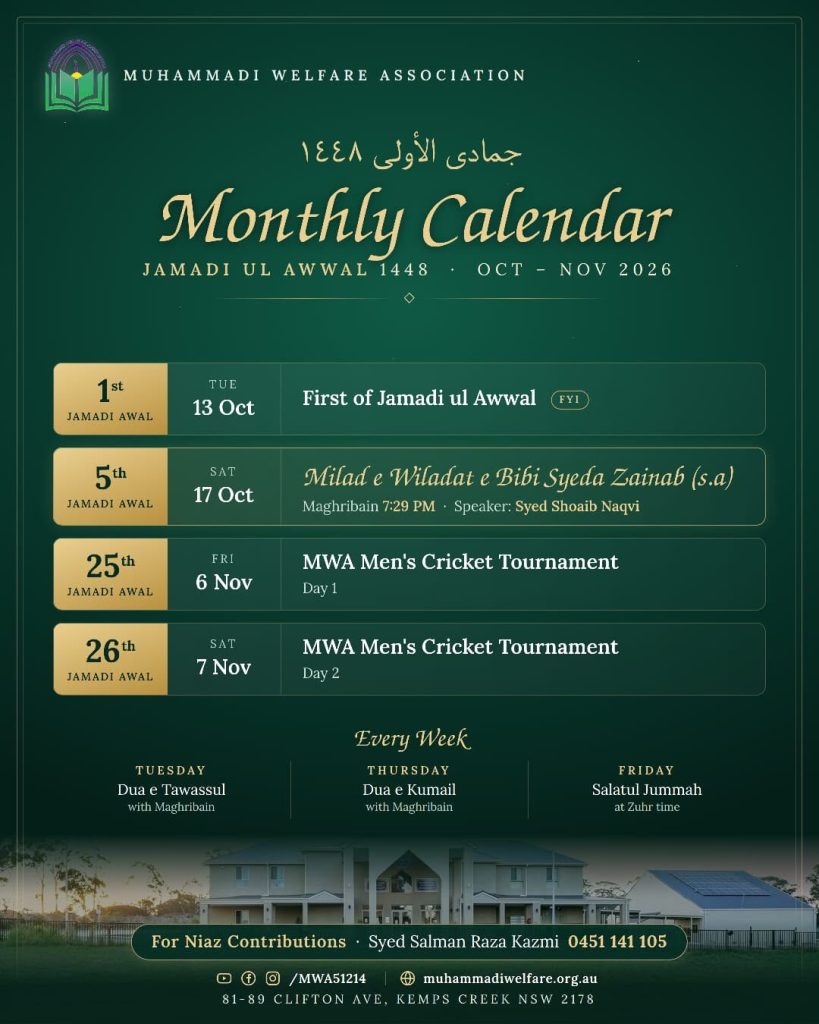
MONTHLY CALENDER

Services We Offer

MWA Services for community

Counselling

MWA offer counselling to it's community members.

Read More

Community Support

MWA has become aware of members of the...

Read More

Cemetery Services

We are pleased to inform you that Alhamdulillah,...

Read More

Community school

MWA has arranged Community Language School for the...

Read More

Recent News & Updates

Adipiscing elit duis volutpat ligula nulla dapibus.

ACCOUNT NAME: Muhammadi Welfare

BSB : 062471

ACCOUNT NUMBER : 10242515

BANK: Commonwealth Bank of Australia

Copyright 2020, All Rights Reserved